
How To
Creating a New Report
CCH Central
How to create a new Report
Create a new Report
- From the Reports tab, select the category and subcategory you want the new report to be in.
- From the task bar click the button Create to create a new report based on the subcategory. The New Report window opens ready for you to assemble the required fields.
- In the New Report window, choose a template from the template drop-down list.
- Enter a name for your report.
- Enter the end date of your report when this is required.
- From the left pane where the Fields are listed, click and drag, for example, the Client Partner field, which you may want to use to group data in your report, into the horizontal bar just below the report title field.
- From the Fields list, click and drag the fields that you want into the field bar just below the grouping bar. A new field can be placed before or after any pre–existing field. A A new field can be placed before or after the fields already on the bar. When dragging or change the order of the fields, the red arrows provide a visual guide to locating items in the field bar.
- You can run your report once you have selected fields to include.
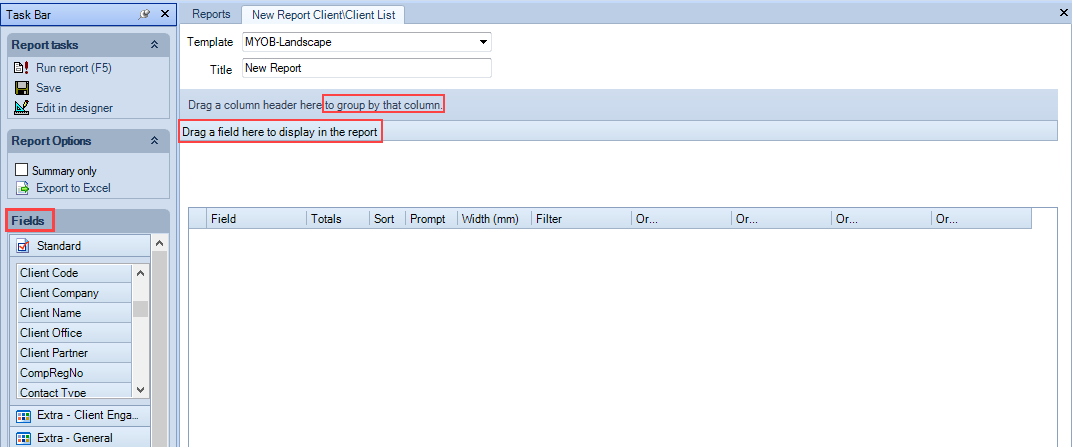
Note: Grouping is optional in a report; you can group by a single field or by several fields.
Note: the red arrows provide a visual guide to locating items in the grouping bar. When multiple fields are selected for grouping the grouping bar increases in size, like that shown below, to allow the fields to display in a tree-like hierarchy.
Note: ensure you save your report regularly if you expect to reuse it. If its an ad hoc query, then you can run it without saving.
Related documents
CCH Central Suite 2026.3 Update Guide
This guide explains how to update an existing install of the CCH Central Suite to the latest version 2026.3 (including Service Packs and Hotfixes) using the Central Suite Installer (CSI).
Central Suite Installer (CSI) instructions
The document announces the update of the Central Suite Installer (CSI) for the CCH Central Suite, now compatible with the latest releases and service packs and hotfixes of various CCH applications. Key points include prerequisites for installation, compatibility information, and the necessity for proper backup before proceeding with the update. It highlights specific requirements for Microsoft components, and it warns users of CCH Accounts Production regarding regional settings for date format. Support options are mentioned for users seeking assistance during the update process. Release notes are accessible for detailed information on the updates.
Setting up users - CCH Central
This document provides a detailed guide on setting up employees in the CCH Central system to integrate with CCH Trust Accounts. It outlines the necessary steps for creating a new employee, including mandatory fields such as unique identifiers, personal details, and security group assignments. The document emphasizes the importance of specific access rights for CCH Trust Accounts users, particularly for preparing accounts and configuration purposes. Additionally, it includes instructions for adding extra security groups as needed.
CCH Conversions - Data categories and descriptions
This document outlines the key components of standing/static/core data and practice management data necessary for client management in professional services. It details the types of essential client information such as unique client codes, contact details, and employee data. Additionally, it includes information on compliance data related to various tax modules and the ability to import financial records into the system. Document management capabilities for electronic files are also mentioned, along with a reference to a comprehensive guide for preparing and auditing practice data.
Importing Data Services: New Customers
The document outlines data importing services for new customers transitioning to the CCH Central database. It details options for populating client and contact information, including self-service imports and professional services support. Customers can manage data quality through templates for import, thereby maintaining high integrity and facilitating a smooth transition. Additionally, the document discusses converting work in progress (WIP) and debt data, offering options for detailed transaction transfers or top-level balances. It emphasizes a seamless migration experience without system downtime, with support available for various data needs.