This is purely for customers using our CCH GDPR Compliance application.

To enhance and provide an extra layer of security in accessing your account, we have introduced multi-factor authentication or MFA. What is MFA, you might ask? An authentication method that requires the user to provide two or more verification factors to gain access to a resource such as an application or online account.

The 2 factors we use are your password and your mobile phone and there are 2 ways in which you may use your mobile phone. The first is to elect to receive the verification code via SMS. You will enter your password and a verification code will be sent to your phone.

The second option is to use what is known as a ‘Time-based One Time Password’, or TOTP. To use the second option, you need to have downloaded to your phone, an app such as Authy, Google Authenticator or Microsoft Authenticator. Setting up the app is simple. Either scan a QR code or enter the code manually to set the service up. Once you are in, the app displays the verification code with a timer, and you can either hide the code or simply copy it.

Time-based One Time Password

To download Google Authenticator, you must go to either Apple App Store or Google Play Store on your phone and download “Google Authenticator”.

To download Microsoft Authenticator, you must go to either Apple App Store or Google Play Store on your phone and download “Google Authenticator”.

For more information on Android and Apple phones , please see: https://www.microsoft.com/en-us/account/authenticator

Text-based authentication

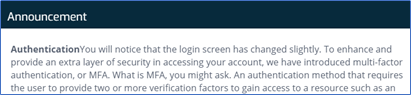
Otherwise, simply choose to use the SMS (Text to Phone) option. When you sign in you will see an announcement. Once you have read the announcement, click OK
clipboard_e77ff118c12df65cc0b0d195286ee1bf1.png

Enter your username and password.

clipboard_e969c012bcc5b349a0789528d055fc5ca.png

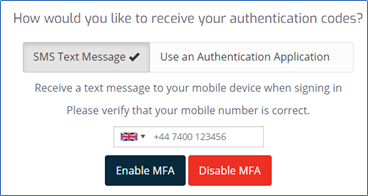
Choose how you wish to receive your MFA codes. HINT: If you don’t see the below screen, click on MFA under your name in the top right-hand corner of the app.
clipboard_e66141cbaaa268169b587a194d01d4ac4.png

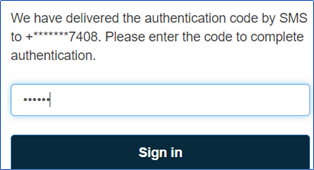
If, like in the above example, you chose SMS then, whenever you log in, a verification code will be sent via SMS.
clipboard_e422456999474412199efafd9a7ba31b1.png

Related documents

Stakeholder training and awareness
The document discusses the importance of staff awareness and compliance in data protection programs within organizations. It highlights the necessity of training employees on relevant policies and providing documentation of their understanding and acceptance. The CCH GDPR Compliance tool is introduced, which allows organizations to distribute policies, track employee receipt and acceptance, and monitor compliance status with visual indicators. It emphasizes the need for a record of training efforts and offers templates for communication, ensuring all employees are informed and compliant.
Simplifying Data Subject Access Requests (DSAR)
This document outlines the rights of individuals regarding their personal data and how organizations can facilitate the exercise of these rights. It emphasizes the importance of allowing easy access to rights through communication channels. The process for handling Data Subject Access Requests (DSAR) is detailed in three steps: receiving and logging requests via a customizable online form, validating requests by confirming the requester's identity, and responding appropriately to the request while ensuring compliance. The document stresses the importance of training staff and maintaining records for accountability and transparency.
Responding to data breaches
This document discusses the importance of effective breach management in compliance with GDPR, highlighting the challenges many organizations face in acknowledging breaches. It introduces CCH GDPR Compliance as a solution, detailing its workflow for logging breaches, managing responses, and assessing incidents. Key features include understanding causes, assembling response teams, risk evaluation, and facilitating communication with supervisory authorities and affected data subjects. The tool also provides downloadable reports and maintains a historical breach log for future learning and prevention efforts.
Ensuring third parties are compliant
This document emphasizes the importance of managing personal data shared with third parties, particularly concerning GDPR compliance. It highlights the necessity for written agreements outlining data processing practices and the need for meticulous logging of data transfers. The document addresses the complexities of sharing data with both processors and controllers, including specific legal obligations when processors are outside the EU. It underscores the distinct legal responsibilities between controllers and processors and recommends mapping these relationships for clarity and compliance. Additionally, it offers tools for generating agreements and recording legal bases for data sharing.
Do you need a Data Protection Officer?
The document emphasizes the importance of human involvement in achieving GDPR compliance, highlighting that organizations must protect individuals' data through established processes. It introduces CCH GDPR Compliance as a collaborative workflow tool where team administrators can grant access to users, including external Data Protection Officers (DPOs). The document outlines the necessity of appointing a qualified DPO based on regulatory requirements and encourages organizations to assess their need for one. For questions regarding DPO appointments, it directs readers to CCH Software Support for assistance.