Fairness through awareness. Repeatedly, we have said compliance is about the team. It goes further than that. An organisation depends on its staff to deliver its data protection programme. Staff must be informed of relevant policies, standards and rules – in fact, the regulation requires it. To demonstrate compliance, it’s important to have a record of these awareness and training efforts.

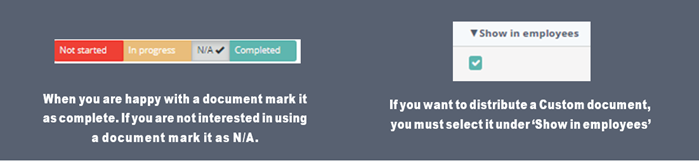
In the Governance section, under the internal and optional tabs, you will find policy and awareness templates you may modify or use as-is to communicate with employees. You can upload your own to the Custom documents section if the templates don’t address all your requirements. Under the Employees section, these documents can then be distributed to staff and their receipt and acceptance are recorded.
clipboard_ea90e3c3f38cbf2b1905b825352e68ded.png

Track your training

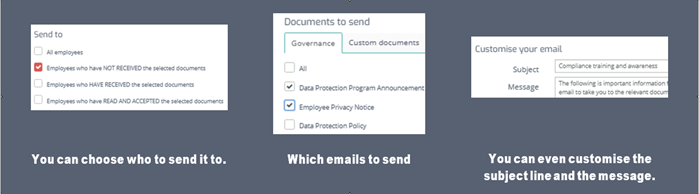
CCH GDPR Compliance is not a learning management system, but it does contain a checklist so you can make sure you have assessed your training and awareness programme to ensure its adequacy. It does create an audit trail of your employees’ acceptance of your policies. Simply add employees and stakeholders to the system, select who you want to distribute which policies to and send them. CCH GDPR Compliance will track who has received them and whether they have read and accepted them.
clipboard_ef97757b805f256e46da67e0be7cdade2.png

Monitor the status

You can monitor the status. After recipients receive an email with a link to the policy they were sent, they can click on "I have read and accept this document." Their acceptance is recorded in CCH GDPR Compliance with a time/date stamp next to each policy.

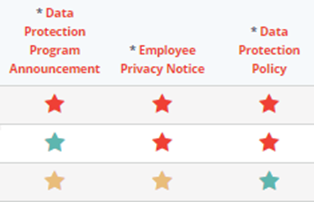
You can download a report, but we also provide a visual report where:

  • A red star indicates they have not received it.
  • A yellow star indicates they have received it but have not read or accepted it.
  • A green star indicates they’ve received and accepted it.
clipboard_e21eee344e4277479ecf393d7bda39e61.png

Related documents

CCH GDPR Compliance  MFA
The document outlines the implementation of multi-factor authentication (MFA) for users of the CCH GDPR Compliance application to enhance account security. It explains that users must provide two factors for access, specifically a password and a verification code sent via SMS or generated through a time-based one-time password (TOTP) app, such as Google Authenticator or Microsoft Authenticator. Instructions for downloading these apps and setting up SMS verification are provided, along with visual aids for the login process and MFA selection.
Simplifying Data Subject Access Requests (DSAR)
This document outlines the rights of individuals regarding their personal data and how organizations can facilitate the exercise of these rights. It emphasizes the importance of allowing easy access to rights through communication channels. The process for handling Data Subject Access Requests (DSAR) is detailed in three steps: receiving and logging requests via a customizable online form, validating requests by confirming the requester's identity, and responding appropriately to the request while ensuring compliance. The document stresses the importance of training staff and maintaining records for accountability and transparency.
Responding to data breaches
This document discusses the importance of effective breach management in compliance with GDPR, highlighting the challenges many organizations face in acknowledging breaches. It introduces CCH GDPR Compliance as a solution, detailing its workflow for logging breaches, managing responses, and assessing incidents. Key features include understanding causes, assembling response teams, risk evaluation, and facilitating communication with supervisory authorities and affected data subjects. The tool also provides downloadable reports and maintains a historical breach log for future learning and prevention efforts.
Ensuring third parties are compliant
This document emphasizes the importance of managing personal data shared with third parties, particularly concerning GDPR compliance. It highlights the necessity for written agreements outlining data processing practices and the need for meticulous logging of data transfers. The document addresses the complexities of sharing data with both processors and controllers, including specific legal obligations when processors are outside the EU. It underscores the distinct legal responsibilities between controllers and processors and recommends mapping these relationships for clarity and compliance. Additionally, it offers tools for generating agreements and recording legal bases for data sharing.
Do you need a Data Protection Officer?
The document emphasizes the importance of human involvement in achieving GDPR compliance, highlighting that organizations must protect individuals' data through established processes. It introduces CCH GDPR Compliance as a collaborative workflow tool where team administrators can grant access to users, including external Data Protection Officers (DPOs). The document outlines the necessity of appointing a qualified DPO based on regulatory requirements and encourages organizations to assess their need for one. For questions regarding DPO appointments, it directs readers to CCH Software Support for assistance.